6th Germany-Korea Hydrogen Conference
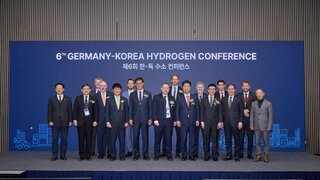
Policymakers, researchers, and industry leaders from Germany and Korea gathered in Ilsan on 3rd December 2025 for the 6th Germany-Korea Hydrogen Conference, focusing on deepening bilateral collaboration in the field of clean hydrogen. Opening remarks by Dr. Jaehong Kim (Chairman/CEO, H2KOREA), Mr. Georg Schmidt (Ambassador of the Federal Republic of Germany to Korea), Dr. Deok-yeol Park (Director General, Hydrogen and Heat Industry Policy Bureau, MCEE), and Dr. Axel Bree (Deputy Director General, BMWE) set the stage for a day of dialogue and collaboration.
Germany and Korea both position themselves as future major hydrogen importers while simultaneously developing strong domestic capabilities. The complementary strengths of each country create significant potential for collaboration: Korea has established itself as a leader in hydrogen refuelling infrastructure and fuel cell vehicles, while Germany brings extensive expertise in electrolyser technology and large-scale hydrogen production. A dedicated session on H2 Policy & Market illustrated how both countries are building systematic policy frameworks to accelerate their hydrogen economies: Korea with initiatives like the world's first Hydrogen Act and the upcoming CHPS auction-based clean hydrogen power market, and Germany with its ambitious electrolyser capacity targets and European market integration. Dr. Klemens Ilse from Fraunhofer IMWS further highlighted that closing the gap between projected and actual hydrogen costs remains a shared challenge that calls for continued international cooperation.
The conference also featured sessions on hydrogen production, utilization, logistics, and safety, highlighting the latest innovations and research collaborations. Organized by Fraunhofer-Gesellschaft, H2KOREA, the German Embassy Seoul, NST, adelphi, AHK Korea, Hochschule Anhalt, Green Hydrogen H2DeKo, BAM, and H2Safe, the event was supported by the German Federal Ministry of Research, Technology and Space, the German Federal Ministry for Economic Affairs and Energy and the Korean Ministry of Climate, Energy and Environment.